Training Tip: Why is Your Horse Afraid of the Trailer?
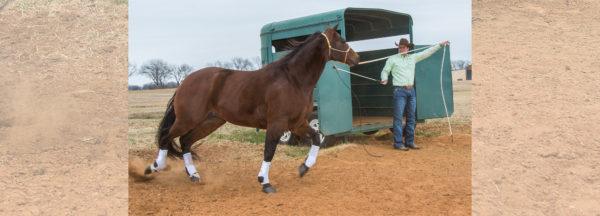
When I was a kid, getting my horse on the trailer always turned into a huge tug-of-war. I’d ask her to step onto the trailer, and she’d fight the halter, rear and back up. My entire family would get involved; we’d run a rope behind her butt and try to push her on the trailer. We tried bribing her on with treats. We yelled at her and waved our arms and stomped our feet. There’d be dogs and three or four big rednecks swearing and cussing. The whole ordeal would turn into nothing but a big circus. For a long time, I thought that was just how getting a horse on the trailer was. You were either lucky and your horse went on a trailer, or you were unlucky and your horse didn’t go on. That seemed to be the case everywhere I went.
It wasn’t until I did my first horsemanship clinic with Gordon McKinlay that I realized how wrong I was. During the clinic, Gordon demonstrated how to teach a horse to load on a trailer and, more importantly, how to make the horse want to get on the trailer. It blew my mind. Not only could I teach my horse how to confidently load on a trailer; I could get her to crave to be on the trailer.
After the clinic, I went home and practiced getting my horse to load on the trailer. Sure enough, I got the same results Gordon did. I was so thrilled that I could get a 1,000-pound animal to willingly do something that she had previously been afraid to do.
What Gordon taught me was to look at trailering from the horse’s perspective. As prey animals, with a flight or fight response, horses prefer to be in big, open spaces where they can easily see predators approaching them and then be able to make a quick getaway. You’ll never see a prey animal having a rest in a tight, narrow space because if a predator came along, he’d be trapped. That’s why, as a general rule, horses don’t like trailers—they make them feel trapped and claustrophobic.
Not only do trailers make horses feel trapped and claustrophobic, but they’re also a scary object. Horses hate objects. What is an object? An object is anything that doesn’t live in your horse’s stall or pasture. Why is it no longer an object if it lives in your horse’s stall or pasture? Because if it lives in your horse’s stall or pasture, your horse sees it every day and gets desensitized to it. Horses especially hate objects that move and make a noise. A trailer does a little bit of everything. It’s an object, it moves, and it makes a noise when the horse walks up on it and as it’s traveling down the road. If you put yourself in your horse’s shoes, trailering can be a traumatic experience, especially when the horse doesn’t understand that the trailer isn’t going to hurt him.
Learning how to teach my horse to confidently load onto a trailer and even want to be on it has been a game-changer for me. Thanks to Gordon McKinlay’s horsemanship clinic, I now understand how to approach trailering from my horse’s perspective. I know that trailers can be scary objects for horses, and it’s my responsibility to help my horse feel safe and comfortable. By desensitizing my horse to the trailer and making it a positive experience, I can ensure that trailering is no longer a traumatic experience for my horse, but rather an enjoyable one.
